Project Overview: Bridging Connection Through Auditory Presence
At Meta Reality Labs, I explored how spatial audio on Ray-Ban Meta (RBM) glasses could enhance phone calls, aiming to create a sense of true audio presence. This project sought to make distant conversations feel like in-person interactions, crucial for users unable to easily connect with loved ones. My goal was to understand if spatial audio could truly foster deeper connection and immersion.
The User Research Challenge: Testing Natural Interaction & Expectations
My evaluative research aimed to understand user preferences for spatial audio in phone calls. I faced two key challenges:
- Eliciting Natural Movement: How could I get users to naturally move in a lab setting, vital for experiencing spatial audio, without explicit instructions or bias?
- Managing User Expectations: Users often expected spatial audio to track with their phone, not the glasses. I needed to prevent this expectation from skewing results.
My hypotheses included users preferring spatial audio when seated, wider ranges of motion for spatialized audio, and head-locked audio when walking.
Methodology & My Role: Designing for Authentic User Insights
I employed a mixed-methods approach, using Qualtrics surveys and qualitative interviews. My role as a UX Researcher was central to overcoming methodological hurdles and extracting user insights:
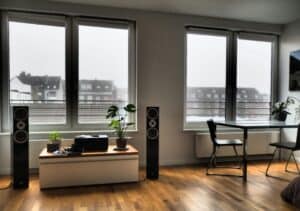
- Innovative “Tidying Up” Task: Working with another UX Researcher, I devised a unique solution to encourage natural movement: users “tidied up” the lab, simulating a real-world phone call scenario that naturally engaged them with the spatial audio.
- Structured Test Conditions: I tested various call conditions (mono/stereo, spatialized/world-locked with different ranges, and head-locked audio) in both seated and walking conditions.
- Bias Mitigation: I ensured the phone was out of view, and the facilitator verbally guided users through condition changes, allowing users to focus solely on the audio.
- Comprehensive Data Collection: I was responsible for recruiting, scheduling, and moderating user study sessions. I conducted qualitative interviews and performed thematic analysis on the collected data. I also played a key role in designing the study protocol and troubleshooting prototypes.
Outcome & Impact: Pivoting with User-Centered Learning
This study, while not confirming initial hypotheses, yielded invaluable insights that directly influenced product strategy. It highlighted the power of learning from unexpected user behaviors.
Key User Insights:
- Users were confused by spatialization and expected audio tracking to be phone-locked, not glasses-based.
- Latency issues emerged during walking, disrupting immersion.
- Users struggled to differentiate subtle spatial nuances, often preferring the simpler mono audio, especially when walking.
- A crucial finding was users’ strong desire for visual context (e.g., an AR avatar or video feed) alongside spatialized audio for true presence.
Strategic Impact & Personal Learnings:
This research provided critical direction for stakeholders:
- It became clear that Spatial Calling, in its current form, was not a high-priority feature for users. This allowed the team to reallocate resources to more impactful, user-desired projects with greater business potential.
- This experience reinforced that research includes failures, and these are often the richest learning opportunities. I gained a deeper understanding of user expectations for spatial audio and the importance of contextual cues.
- This project showcased my ability to adapt, troubleshoot, and extract strategic insights even when initial assumptions are disproven. It demonstrates my capacity to find value in unexpected outcomes and help teams make informed pivots.